
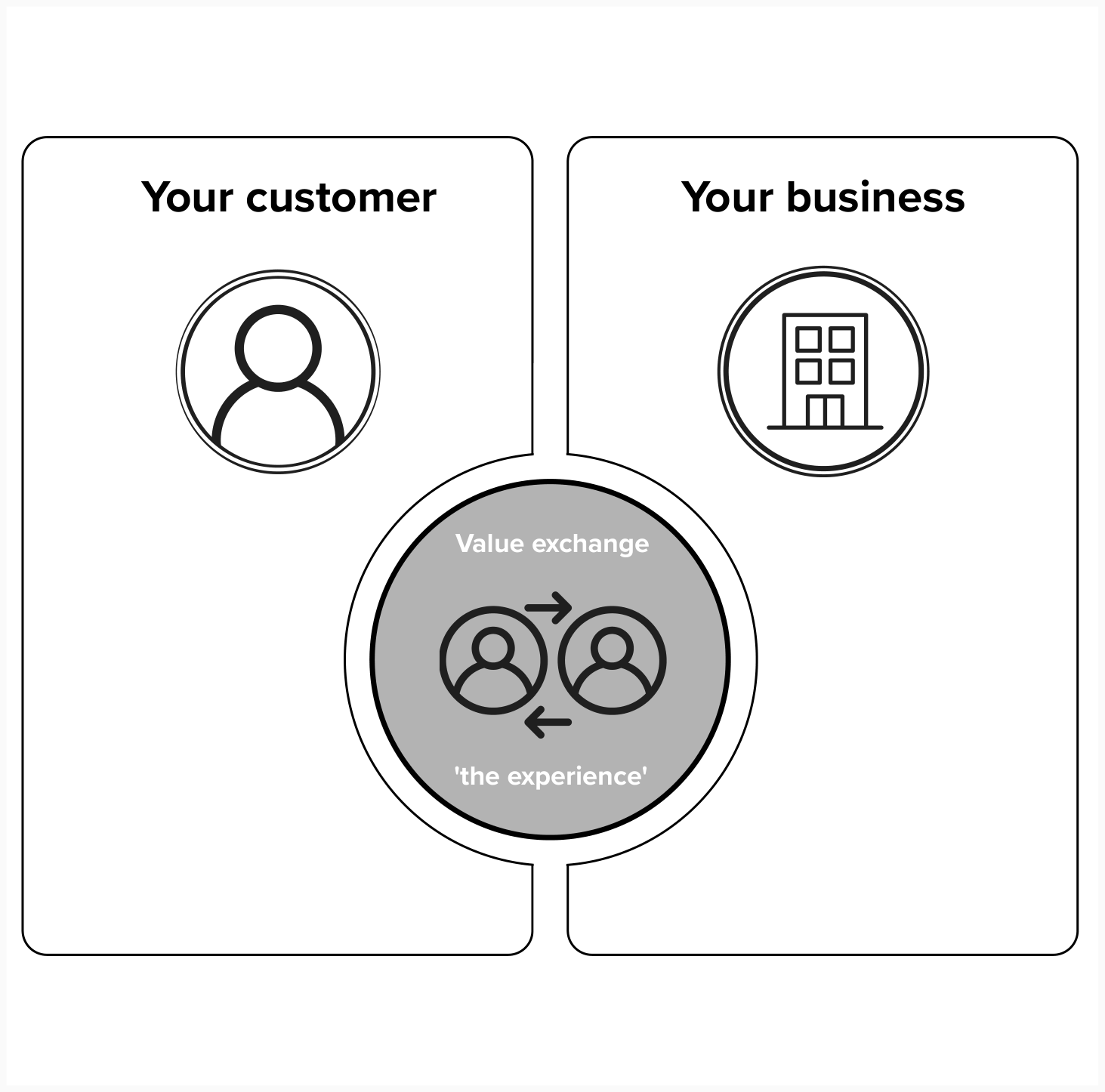
When working with technology leaders and teams over the years, I’ve realised that at some point reasonably early on in the engagement there is a requirement to break down what is meant by an ‘experience’ and how that relates to a specific organisational context. I’ve created a simple model that allows me to do this effectively, and I want to share it with you.
For some clients, this may be the first time they have explicitly thought about ‘experience’ as a concept, and for others it may be a helpful codification of what they already intuitively understood. Eitherway, I’ve found keeping it clear and accessible is key. The purpose here is to provide an accessible explanation to help your client engage in the work you are doing. It isn’t a deep dive into the psychology of human experience, value proposition development or organisational operating models. I’ve used this model with technical service owners to collect data on existing services as part of an internal customer segmentation project. I’ve also used it in a leadership session on the importance of measuring customer experience. But being relatively simple, it should work in any context.
Before I share the model, I want to credit two people who’s thinking has influenced me heavily over the years, including with this model – Steven Walden and Lincoln Murphy – both great thought leaders in the CX and CSM space. Specific references are provided at the end.
Defining the importance of experience
First I kick off with a definition:
Success for your customer and you is when your customer achieves their desired outcome through their interactions with you.
This is a very intentional statement with two key words to call out:
- Desired outcome. Your customer has engaged with your proposition for a reason – to achieve some goal or objective. Being able to do that is fundamentally the minimum requirement of your service. However, they have come to your proposition with some expectations of what the experience should be like, for example, quick, easy, caring, etc. This will be based on previous interactions with you, maybe your reputation, or projected from similar encounters with other related brands. For your customer, achieving their goal in the way they expected is a positive experience.
- Interactions. This one is so key it cannot be underplayed. At some point, in order to attempt to achieve their outcome, a customer must interact with your proposition, be that via a human, AI or any myriad of digital channels. It is at this point value is exchanged between you and your customer, and that cannot happen without some ‘experience’. Every moment you have in life, not just business, is ‘experienced’ through your senses, your thoughts, emotions, and your behaviours.
So, when a customer interacts with your proposition to get value, they are having an experience. You can’t get away from this fact. The question is, should some of the experiences be managed rather than left to chance? A customer’s experience of value delivery is not enough on its own – the product or service must have utility first in order to deliver value for the customer – but it can be what differentiates you from competitors. Good experiences of value delivery will drive benefits to your business, for example, returning customers and reduced churn, increased revenue, and advocacy. For internal customers it may be improved levels of productivity, reduced cost to serve, advocacy, or fewer tickets.
Situating experience
With the definition understood, the next step is to situate experience in relation to high-level customer and operational components. This is important because it allows your client to consider their relationship to the customer and their experience, and begin to grasp the connection between what they do and the ability for a customer to achieve their desired outcome.

Two worlds collide – that of your customer and your organisation – through one or more interactions, where value is exchanged and your customer has their experience.
Coming into that interaction, your customer has:
- An outcome they desire to achieve, for example, satisfying hunger.
- Thoughts and feelings about doing this, for example, “I need to be quick”, “Pret* is close”, “I’m trying to save money”.
- Preconceptions about the whole thing, for example, “Pret is quick”, “I like Pret coffee”.
These direct your customer’s energy and action toward your proposition and the interaction.
Your business, however, also comes into that interaction with many things at play:
- Specific channels through which your customer must engage – website, coffee shop, email, telephone.
- Your employees, also humans with their own goals, thoughts, feelings and expectations.
- Processes, technology and policies that will impact the nature and quality of the interaction, for example, point of sale terminals, networks, stock, coffee machines, suppliers, hygiene regulations to maintain, sales targets to meet, etc…
- A team, department or organisation purpose, vision and current strategy that will be shaping many of these elements.
When you reflect on everything that is occurring in this moment, you might wonder how it ever happens effectively, but it does!
Watch out for feedback loops
- The quality of your customer’s experience has a feedback loop. It makes an impression in memory, and may influence their attitudes, beliefs and expectations next time. Maybe your customer will choose another sandwich shop nearby next time…
- A thoughtful business should have their own feedback loop where customer and employee experience data is collected, be that from the customer, the employee or behavioural data from the technology being interacted with. This can then influence product and service development, operational models and ultimately your vision and strategy.
Suggestions on how to use this model
Whilst this model is a useful tool to define and situate experience in many business situations, it can also be used to ask questions about the level of integration of customer-centricity within a team, department or business.
Using the elements in the model we could start reflecting on the following:
- How much do I understand my customer?
- Are we clear what are they trying to achieve and why?
- Are we clear what their expectations are about the experience?
- Are we clear what their attitudes are about us?
- Do we know all the interactions our customers could have with us?
- Are we clear what channels they occur on?
- Are there clear processes to handle different interactions such as complaints?
- Do we know what kind of experiences we currently deliver?
- Do we have our own feedback loop in place with customers?
- What do our employees think and feel?
- Do we have some common measures that tell us how we are doing?
- Do we know what is causing the experiences?
- Have we ever done any root cause analysis?
- Are our policies or processes negatively impacting the delivery of value?
Beginning to answer these questions may lead you to consider taking some action on the journey towards improved customer experience. It doesn’t have to be big, complex and expensive. Executing customer-centricity can start small, be quick and relatively simple.
Organise a free 30-minute call to discuss how your proposition fairs using this model by emailing barry@loveit.works
*Other great sandwich brands are available 😉
References
- Steven Walden, Customer Experience Management Rebooted, 2017
- Lincoln Murphy, Sixteen Ventures – https://sixteenventures.com/customer-success-definition#desiredoutcome
Leave a Reply