
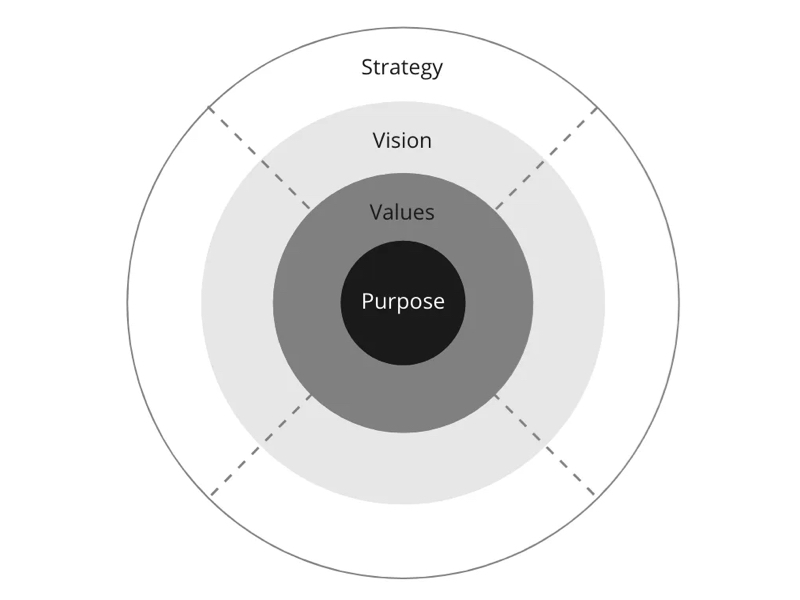
I’ve worked in business for over 20 years, mainly in or around the field of design. Surprisingly I find design still faces the same challenges it did 20 years ago —a lack of understanding and consequently under par adoption and engagement. I have come to realise many problems in organisations, including those faced by design, are linked to an inadequate articulation of, and alignment throughout the business to, a purpose and vision. Ultimately the consequence is profitability.
Poor execution of purpose and vision
There are five issues I’ve currently observed in relation to poor execution of purpose and vision:
- The lack of a common definition of what a purpose, vision, strategy and a value is, leading to poor articulation by organisations.
- Limited knowledge about the interdependency between them.
- Their absence within organisations — some are just missing, have never been articulated, or are have no presence in the organisation.
- The limited utilisation of them to driving business, including the role they could play in annual planning and financial budgeting.
- Poor cascading from the Executive office, through the leadership team, and into the major business entities and beyond.
The cost of poor execution
It seems plausible to infer the consequences of poor execution can be wide-reaching on a business. Below are a handful of observed consequences:
- Misalignment between the leadership team and the rest of the business;
- Misalignment between and within business entities.
- Strategies that are not connected to a vision and therefore a purpose.
- Misdirected investment in initiatives and on operational cost that don’t connect to the purpose, vision and strategy.
- Negatively impacted employee engagement through a poor connection to purpose, subsequently influencing retention of talent.
All of these, and no doubt many others, represent financial and non-financial risks to any organisation. One useful point of reference of the true cost of poor execution is from the book Firms of Endearment. The authors discovered that organisations who lived and breathed their purpose and vision returned 1026% for investors over 10 years compared to the 122% for the S&P 500.
Definitions — a starting point to improve execution
As is often the case, great execution must start with shared understanding and awareness. To that end, in this article I share my current definitions of 4 key components — purpose, values, vision and strategy.
These definitions I use in my work, to shape conversations, develop shared understanding, audit an organisation’s existing components, or create new ones. They act as a tool that forms the basis of determining what work needs to be done to improve execution. They are a work in progress and will evolve.
Purpose
An organisation’s purpose:
- Makes clear the reason it exists, the ‘why’, the problem it solves, often traced back to the reason the organisation was originally founded.
- Represents something bigger than the business and just profit – a contribution to a common good, to improving people’s lives, and agent of wider change.
- Represents and impacts multiple stakeholders — customers, employees, partners, shareholders, communities, and the planet.
- Implies fundamental human need(s) of the stakeholders being met.
- Draws upon and references your organisation’s DNA — what your organisation excels at.
- Is stable over time — your purpose doesn’t really change.
- Is well known by all stakeholders.
- Is evident in corporate governance structures.
- Has measures of performance of how well it is being fulfilled.
Vision
An organisation’s vision:
- Represents a future state where the organisation is fulfilling its purpose for one or more stakeholders.
- Is aspirational — a challenge for the organisation.
- Is inspiring to stakeholders, giving them hope, driving a connection with and a motivation for achieving the vision.
- Presents a future state in a specific timeframe, often a handful of years
- Is a pre-cursor to any business strategy.
- Is vivid and detailed at different levels of the organisation, driving plans or action and behaviour.
- Is committed to by leadership.
Values
An organisation’s values:
- Originate from stakeholders needs: what they need = what they value.
- Often reflect the values of the organisation’s founders.
- Represent the collective needs of stakeholders for a period of time.
- Represent intentions, and are represented in how we behave.
- Are mostly stable over time, but do periodically shift, reflecting a maturing organisation and the shift in stakeholder needs.
Strategy
Strategies within an organisation:
- Are a description of the major activities required to realise a vision and thereby fulfil a purpose.
- Are organised into a structured plan, which may contain phases of work with specific outcomes.
- Are time bound as its intent is to achieve a specific vision, which is itself time bound.
- Have defined measurements congruent with the purpose and vision to monitor progress against realising them.
Returning to purposeful business has become of key importance
There was a period of time, dating as far back as the Romans, where businesses were often established with a clear public purpose — collecting taxes, maintaining public properties, building roads and railways, establishing telecommunications infrastructure, supplying energy.
Business acted as agents of positive change for societies and nations, however, the gradual dispersal of business ownership to shareholders and the emergence of the Friedman Doctrine in the 1950’s set the tone for business as we know it today, one dominated by the pursuit of profit over purpose.
Such a pursuit has had many negative consequences, and in no small part has contributed to a rising gap between the have and have-nots, a mental health crisis amongst our teenagers and young adults, and of gravest concern a planet at risk of permanent damage that could impact all our lives and those of generations to follow.
If we adopt the view that organisations are the essential agents of change in society, executing well on purpose, vision, values and strategy well is step number 1. As Lise Kingo, CEO and executive director of the UN Global Compact, stated,
The idea of business as an agent of change and a purveyor of positive values is gaining traction and legitimacy around the world. With a growing number of companies taking steps to be more responsible in how they treat employees, communities, and the planet, we are seeing business emerge as a real player and solution-provider in the quest to put our world on a better course.
A point of reflection to end with
Consider your answers to the following questions in relation to Purpose, Values, Vision and Strategy:
- Can you, right now, without referring back to any document, recite your organisation’s purpose?
- To what extent does your organisation’s purpose, values and vision informed the strategy for your part of the business (maybe your business unit, your team, your product), and feature in the policy, governance, processes and systems where you work?
- And lastly, do you, or does anyone in your organisation, know how well your business is doing financially because it is living it’s purpose and values through it’s vision and strategy?
Useful sources of information
Over time several sources have contributed to the current state of these definitions. I include some below for your interest.
- Barrett (2017) The Values-driven organization. Cultural health and employee well-being as a pathway to sustainable performance. Routledge (UK)
- Hardy (2022) Be your future self now. The science of intentional transformation. Hay House (US)
- Lafley & Martin (2013) Playing to win. How strategy really works. Harvard Business Review Press (US)
- Sinek (2009) Start with why. How great leaders inspire everyone to take action. Penguin (US)
- Sisodia, Wolfe & Sheth (2014) Firms of endearment. How world-class companies profit from passion and purpose. Pearson (US)
- Smith &Milligan (2011) Bold: How to Be Brave in Business and Win. KoganPage (UK)
- Wickman (2011) Traction. Get a grip on your business. Ben Bella (US)
- https://www.thebritishacademy.ac.uk/publications/future-of-the-corporation-principles-for-purposeful-business/
- https://www.thebritishacademy.ac.uk/documents/76/Reforming-Business-for-21st-Century-British-Academy.pdf
- https://sergiocaredda.eu/organisation/organisation-design/purpose-the-theory-and-the-practice/
- https://hbr.org/2014/09/your-companys-purpose-is-not-its-vision-mission-or-values?registration=success
- https://www.ideou.com/blogs/inspiration/activity-4-steps-to-define-your-purpose
- https://medium.com/the-mission/three-key-elements-your-company-story-needs-130c72df60b0
- https://www.cadbury.co.uk/about-bournville
Leave a Reply